.png?width=1344&height=768&name=Adobe%20Express%20-%20file%20(1).png)
Learning Objectives:
- Define GTM motion and explain its eight key components: Target market, Value proposition, Distribution channels, Revenue model, Sales/Marketing alignment, Customer Success, Technology/Tools, Metrics/KPIs
- Compare three primary GTM motion types: Product-Led Growth (PLG), Sales-Led Growth (SLG), Marketing-Led Growth (MLG)
- Analyze hybrid GTM strategies from HubSpot, Slack, and Zoom combining PLG/MLG/SLG approaches
- Navigate customer transitions from PLG to SLG reframing CSM value for self-service customers
- Execute seamless post-sales handovers in SLG motion ensuring continuity and trust
- Connect successful post-sale CS strategy to Net Dollar Retention growth driving company viability
━━━━━━━━━━━━━━━━━━━━━━━━━━━━━━━━━━━━━━
Introduction
GTM (Go-To-Market) motion refers to the strategic plan and operational approach a company uses to bring its product to market and achieve business goals. It outlines how the organization will deliver value proposition to customers, engage with target market, and drive revenue through combination of sales, marketing, and customer success strategies aligned to ensure product success.
Understanding GTM motion is critical for CSMs because it fundamentally shapes customer expectations, engagement preferences, and when/how CSM is introduced to relationship. A customer acquired through Product-Led Growth expects different experience than one acquired through Sales-Led motion, and CSMs must adapt their approach accordingly to meet these expectations while driving retention and expansion.
The Cost of Not Understanding GTM Motions
Without GTM motion literacy, CSMs may:
- Misalign engagement approach with customer expectations (e.g., high-touch for PLG customers expecting self-service)
- Struggle during customer transitions from PLG to SLG not understanding how to reframe CSM value
- Miss expansion opportunities by not recognizing signals unique to each GTM motion
- Create friction during sales-to-CS handoffs because they don't understand what was promised during sales cycle
- Fail to position CS value appropriately for customers acquired through different motions
- Provide inconsistent experiences across customer segments acquired through varying GTM approaches
The Benefits of Mastering GTM Motion Understanding
GTM motion fluency enables you to:
- Adapt engagement approach based on how customer entered relationship matching their expectations
- Execute smooth transitions from PLG to SLG reframing CSM value for self-service customers
- Align with Sales on SLG customer handoffs ensuring seamless continuity and trust
- Identify expansion opportunities specific to each motion (PLG: usage-based upgrades, SLG: strategic upsells)
- Position CS value differently across motions: PLG customers need strategic guidance, SLG customers expect high-touch partnership
- Contribute to GTM strategy evolution providing customer insights that inform motion optimization
━━━━━━━━━━━━━━━━━━━━━━━━━━━━━━━━━━━━━━
PART 1: THE EIGHT COMPONENTS OF GTM MOTION
Every GTM motion combines these eight elements in different ways based on product, market, and company strategy.
━━━━━━━━━━━━━━━━━━━━━━━━━━━━━━━━━━━━━━
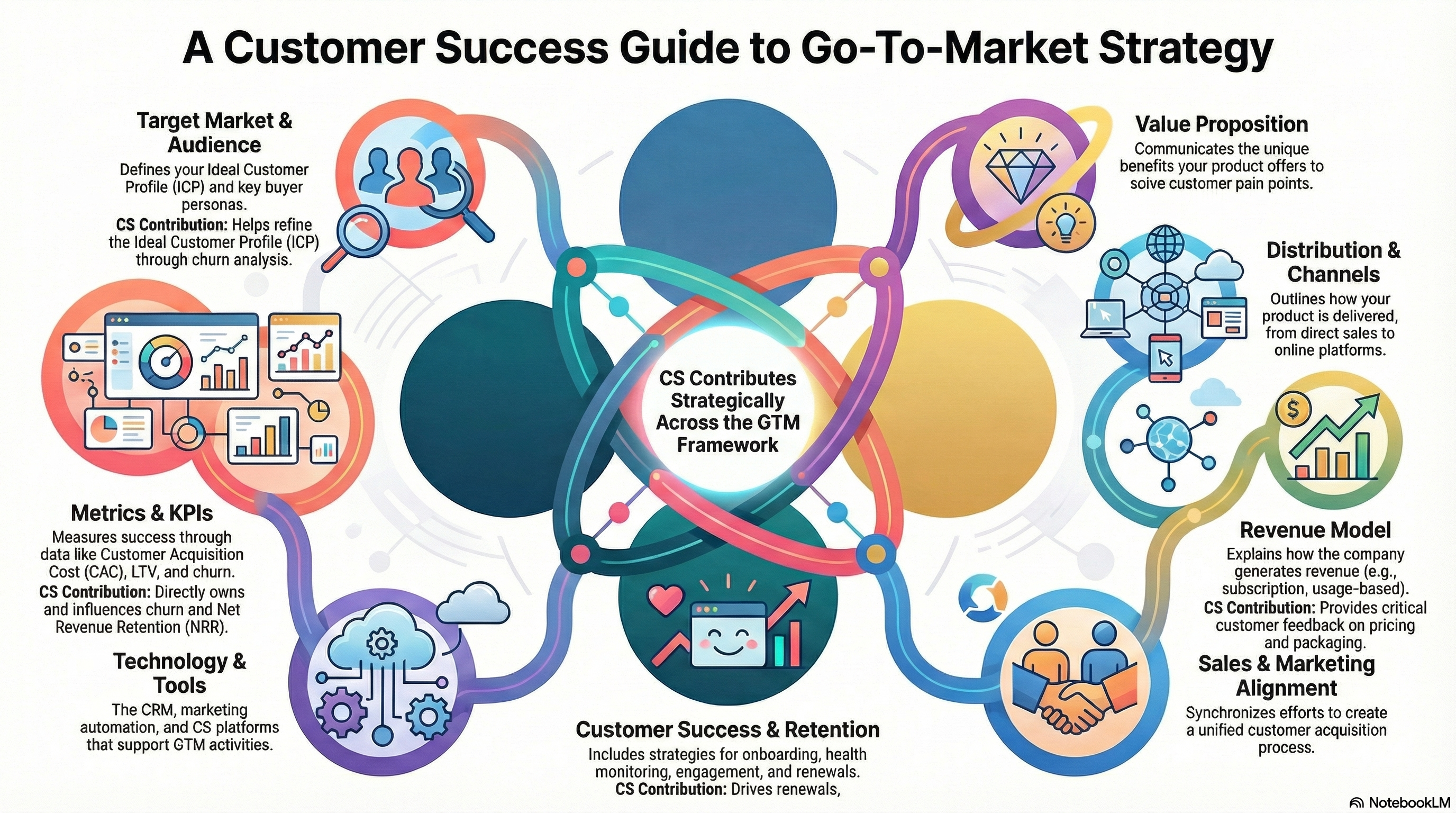
Component 1: Target Market and Audience
What it is: Identifies ideal customer profile (ICP) and buyer personas the GTM motion targets.
Includes:
- Market segmentation (industries, geographies, company sizes)
- Buyer personas (roles, pain points, decision criteria)
- Customer firmographics (revenue, employee count, tech stack)
Component 2: Value Proposition
What it is: Defines unique value or benefits product offers to customers.
Includes:
- How offering solves customer pain points
- Competitive differentiation
- Measurable outcomes customers achieve
Component 3: Distribution and Channels
What it is: Methods for delivering product to customers.
Options:
- Direct sales (enterprise sales teams)
- Channel partners (resellers, integrators)
- Online platforms (self-service signup)
- Hybrid approaches (combination)
Component 4: Revenue Model
What it is: How company generates revenue from customers.
Common SaaS models:
- Subscription (monthly/annual recurring)
- Usage-based (pay for consumption)
- Freemium (free tier + paid upgrades)
- Hybrid (base subscription + usage charges)
Component 5: Sales and Marketing Alignment
What it is: Synchronized efforts creating unified customer acquisition process.
Includes:
- Demand generation strategies
- Lead nurturing and scoring
- Conversion optimization
- Pipeline management
Component 6: Customer Success and Retention
What it is: Strategies for onboarding, support, engagement driving renewals and upsells.
Includes:
- Onboarding programs
- Health monitoring
- Renewal processes
- Expansion playbooks
Component 7: Technology and Tools
What it is: CRM, marketing automation, analytics platforms supporting GTM activities.
Includes:
- Salesforce/HubSpot for customer data
- Marketing automation (Marketo, Pardot)
- CS platforms (Gainsight, Totango)
- Analytics and BI tools
Component 8: Metrics and KPIs
What it is: Key metrics measuring GTM motion success and guiding optimization.
Common metrics:
- Customer Acquisition Cost (CAC)
- Revenue growth rate
- Churn rate
- Customer Lifetime Value (CLV)
- Sales cycle length
- Conversion rates
💡 Pro Tip: Map which of the 8 GTM components CS directly impacts. Typically: Component 6 (CS/Retention obviously), Component 8 (metrics like churn/NRR), Component 4 (revenue model through pricing feedback), Component 1 (ICP refinement through churn analysis). Understanding CS's influence across GTM helps you contribute more strategically beyond traditional CS scope.
━━━━━━━━━━━━━━━━━━━━━━━━━━━━━━━━━━━━━━
Best Practices: GTM Component Understanding
- Learn all eight GTM components to see complete go-to-market system beyond CS function
- Identify which components CS directly impacts (typically 3-4 of the 8) to focus strategic contributions
- Understand how CS role varies based on GTM motion emphasis (PLG vs. SLG vs. MLG)
- Provide feedback on ICP and buyer personas based on retention and churn patterns by segment
- Contribute to revenue model discussions through customer pricing feedback and packaging preferences
- Align CS metrics with overall GTM KPIs ensuring CS measurement supports broader motion success
- Collaborate cross-functionally on GTM components requiring coordination (Sales/Marketing alignment, Technology stack)
- Use GTM framework to communicate CS value in strategic terms leadership uses for planning
━━━━━━━━━━━━━━━━━━━━━━━━━━━━━━━━━━━━━━
PART 2: THE THREE GTM MOTION TYPES
Understand how different acquisition motions shape customer expectations and CS engagement models.
━━━━━━━━━━━━━━━━━━━━━━━━━━━━━━━━━━━━━━
Product-Led Growth (PLG)
How it works: Product itself is primary driver of customer acquisition and expansion.
Characteristics:
- Self-service onboarding (no sales involvement)
- Freemium or trial models (try before buy)
- Low-touch initial experience (automation > humans)
- Viral growth through user sharing
- Expansion driven by usage and value demonstration
Examples: Dropbox, Slack freemium tiers, Zoom free accounts, Notion personal plans
CS Role in PLG:
- Introduced later in customer journey (after upgrade to paid)
- Focus on scaling successful self-service users
- Help transition from individual to team/enterprise usage
- Identify power users ready for strategic engagement
Sales-Led Growth (SLG)
How it works: Dedicated sales team engages with potential customers before purchase.
Characteristics:
- High-touch sales process (demos, proposals, negotiations)
- Suited for enterprise or complex solutions
- Higher contract values (typically $10K+ annually)
- Longer sales cycles (3-12 months)
- CSM introduced immediately post-sale
Examples: Salesforce Enterprise, SAP, Oracle Cloud
CS Role in SLG:
- Introduced during sales process or immediately after close
- High-touch engagement from day 1
- Strategic partnership expectations
- Renewal and expansion conversations ongoing
Marketing-Led Growth (MLG)
How it works: Marketing efforts attract and nurture leads through content, campaigns, and branding.
Characteristics:
- Content marketing and thought leadership
- Broad awareness building
- Lead nurturing through email campaigns
- Webinars and educational resources
- Self-service with marketing support
Examples: HubSpot Academy, Atlassian Community
CS Role in MLG:
- Scaling support through content and resources
- Community building and peer learning
- Automated nurture campaigns
- Selective high-touch for strategic accounts
Hybrid GTM Strategies
Most successful SaaS companies use combinations:
HubSpot Example:
- PLG: Free CRM attracting users
- MLG: Extensive content marketing and Academy
- SLG: Sales teams targeting mid-market and enterprise
CS approach varies by segment:
- Free CRM users: Automated onboarding, self-service resources
- Mid-market: Standard CSM engagement, quarterly check-ins
- Enterprise: Dedicated strategic CSM, monthly executive reviews
Slack Example:
- PLG: Free tier for easy adoption by small teams
- MLG: Marketing campaigns showcasing use cases
- SLG: Enterprise sales for large organizations
Zoom Example:
- PLG: Freemium model for individuals
- MLG: Reliability and ease-of-use messaging
- SLG: Direct sales for enterprise with custom needs
━━━━━━━━━━━━━━━━━━━━━━━━━━━━━━━━━━━━━━
Best Practices: GTM Motion Navigation
- Understand which GTM motion your company primarily uses to align CS approach with customer acquisition model
- Recognize hybrid strategies combining motions and adapt engagement by customer acquisition path
- For PLG customers, reframe CSM value as strategic enhancement to self-service experience
- For SLG customers, ensure seamless handoff from sales with documented goals and commitments
- For MLG customers, leverage content and community alongside personal engagement
- Identify which customers transitioned between motions (PLG to SLG) requiring expectation reframing
- Use GTM motion understanding to set appropriate customer expectations about CS engagement model
- Provide feedback to leadership on which GTM motions produce stickiest customers for strategy refinement
━━━━━━━━━━━━━━━━━━━━━━━━━━━━━━━━━━━━━━
PART 3: NAVIGATING CUSTOMER TRANSITIONS AND INTRODUCTIONS
Execute effective CSM introductions and transitions based on customer's GTM journey.
━━━━━━━━━━━━━━━━━━━━━━━━━━━━━━━━━━━━━━
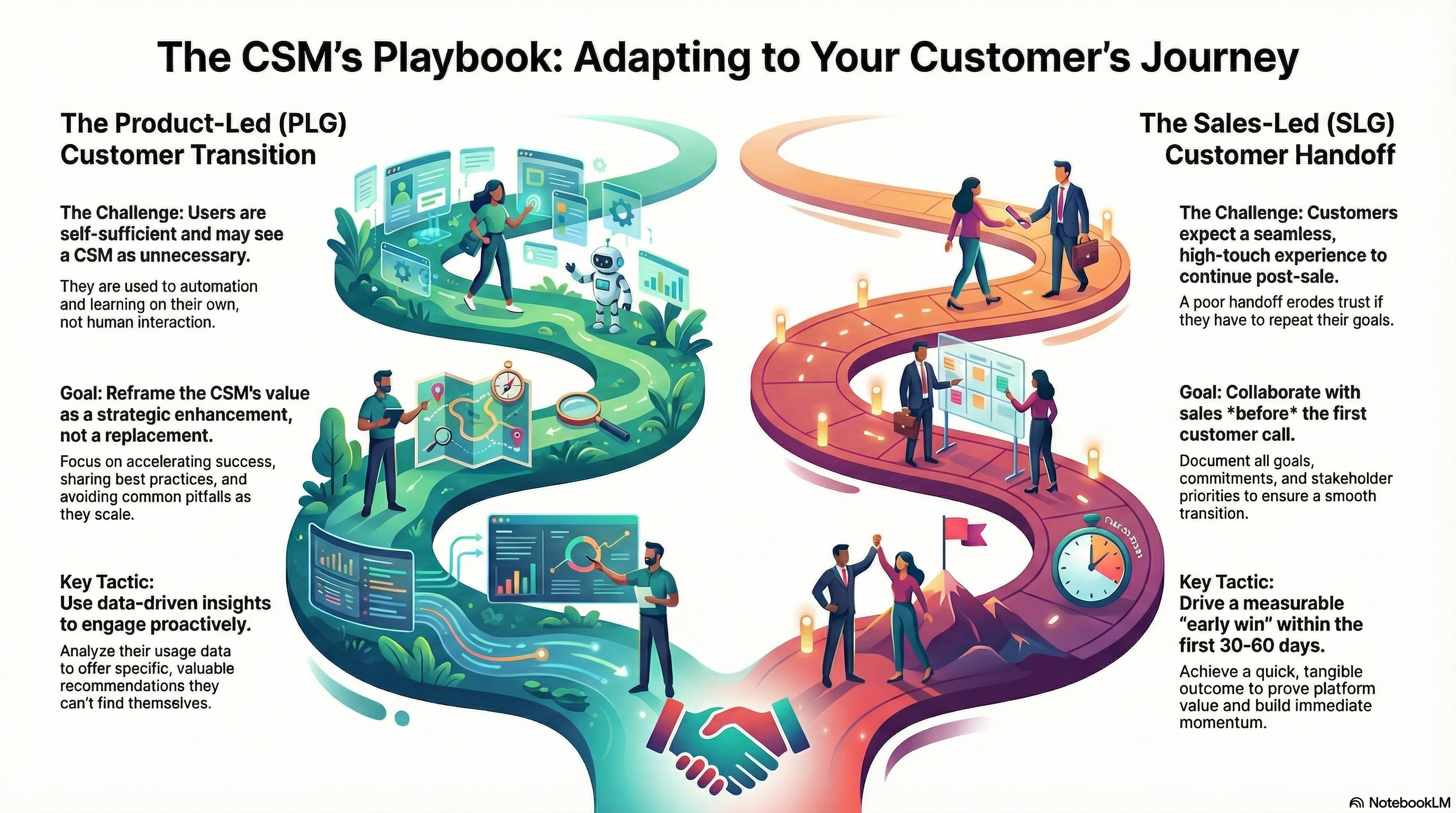
Transitioning Customers from PLG to SLG
The Challenge:
Customers entering through PLG are accustomed to:
- Self-sufficiency and automation
- Minimal human interaction
- Learning through documentation and UI
- Paying for product value, not services
When they upgrade, introducing CSM can feel:
- Unfamiliar (why do I suddenly have a contact person?)
- Unnecessary (I've been successful without help)
- Potentially intrusive (I prefer self-service)
CSM's Three-Step Transition Approach:
Step 1: Reframe Expectations - Communicate CSM Value
How to introduce yourself:
Poor introduction: "Hi, I'm your new CSM. I'm here to check in regularly and make sure you're happy with the product."
Strong introduction: "Hi [Name], congrats on upgrading to Pro tier! I'm [CSM Name], and I work with customers at your tier to help them maximize their investment. I noticed you've been successfully using [Features] - many customers at this stage benefit from strategic guidance on [advanced capabilities] and [integration opportunities]. I'm here to accelerate your success and help you avoid common pitfalls as you scale. How about a quick 20-minute call to discuss your goals?"
What to emphasize:
- You're here to enhance, not replace, their self-service success
- Strategic benefits: Advanced features guidance, Best practice sharing, Avoiding pitfalls, Scaling efficiently
- You respect their independence: "I'm available when you need me, not micromanaging"
Step 2: Bridge the Gap - Show Complementary Value
How CSM complements product-led experience:
- Product provides: Features and functionality
- CSM provides: Strategic guidance on which features fit your use case
- Product provides: Documentation on how things work
- CSM provides: Best practices from similar customers on what actually works
- Product provides: Self-service onboarding
- CSM provides: Customized success plan based on your specific goals
Step 3: Use Data-Driven Insights for Proactive Engagement
Don't wait for customer to need you—demonstrate value proactively:
Example first touchpoint: "I analyzed your account usage and noticed:
- Strong adoption of Features A and B (you're in top 25% of users)
- Feature C unused, which typically adds 40% more value for customers like you
- Your team grew from 5 to 12 users in 2 months (scaling quickly)
Based on this, I have 3 recommendations for maximizing your ROI. Would 15 minutes this week work to discuss?"
Why this works:
- Demonstrates you've researched their account (not generic)
- Provides specific insights they don't have (value-add)
- Offers concrete recommendations (action-oriented)
- Makes CSM feel helpful, not intrusive
━━━━━━━━━━━━━━━━━━━━━━━━━━━━━━━━━━━━━━
CSM Introduction in SLG: The Post-Sales Handover
The Challenge:
In sales-led motion, customers engage with sales reps before purchasing and expect:
- High-touch experience continuing post-sale
- CSM understanding their goals from sales discussions
- Immediate value delivery on commitments made
- No friction in transition from sales to CS
Risks of poor handoff:
- Customer repeats their story to CSM (frustrating)
- CSM unaware of sales commitments (trust erosion)
- Disconnect between what was sold and what CS delivers (disappointment)
CSM's Three-Step Introduction Approach:
Step 1: Collaborate with Sales for Seamless Handover
Pre-handoff (before customer contact):
CSM reviews with AE:
- "What goals did customer share during sales process?"
- "What commitments were made about timelines, features, outcomes?"
- "Who are key stakeholders and what are their priorities?"
- "Any concerns or objections that came up we should address?"
- "What made them choose us over competitors?"
Document everything:
- Customer's stated goals and success criteria
- Timeline commitments (go-live dates, milestone expectations)
- Stakeholder map (decision-makers, champions, end-users)
- Feature commitments and limitations discussed
- Pricing and contract terms agreed
Step 2: Establish Credibility in Introduction Call
Introduction call structure (30 minutes):
Demonstrate preparation (5 min): "Hi [Name], I've been reviewing your account with [AE Name] and understand your goals are [goal 1] and [goal 2]. You mentioned during sales process that [specific pain point]—that's exactly what we'll focus on solving together."
Why this works: Customer doesn't repeat themselves; sees you're prepared
Validate sales commitments (10 min): "[AE Name] outlined this success plan: [commitments]. Let me validate this aligns with your expectations and adjust if needed."
Why this works: Builds trust through transparency; prevents misalignment
Outline onboarding roadmap (10 min): "Here's our plan to achieve your goals:
- Week 1-2: [Milestones]
- Week 3-4: [Milestones]
- Month 2-3: [Milestones]
Does this timeline work for your team?"
Set expectations (5 min): "I'll be your primary contact. You can expect [communication cadence]. We'll measure success by [metrics]. Any questions about how we'll work together?"
Step 3: Drive Early Wins - Build Momentum
First 30-60 days focus:
Implement quick successes showcasing platform value:
- Activate core features solving immediate pain points
- Achieve one measurable outcome (time saved, process improved)
- Build stakeholder confidence in partnership
Example early win:
Customer goal: Reduce lead response time from 24 hours to 2 hours
CSM drives:
- Week 1: Configure automated lead routing
- Week 2: Set up instant notifications for sales team
- Week 3: Implement follow-up sequences
- Week 4: Measure results: Response time now 1.5 hours (95% improvement)
Impact:
- Exceeds stated goal (2 hours target, achieved 1.5 hours)
- Demonstrates platform value concretely
- Builds confidence for tackling additional challenges
- Creates foundation for long-term partnership
Why early wins matter:
Successful post-sale strategy builds partnership ultimately resulting in:
- Greater customer commitment
- Expansion opportunities emerging naturally
- Strong Net Dollar Retention (>100%)
- Long-term viability for SaaS company
━━━━━━━━━━━━━━━━━━━━━━━━━━━━━━━━━━━━━━
Best Practices: GTM Motion Navigation
- Understand which GTM motion each customer entered through: PLG (self-service), SLG (sales-engaged), MLG (marketing-nurtured)
- For PLG customers, reframe CSM as strategic enhancement not replacement for self-service they value
- Use data-driven insights proactively to demonstrate value before PLG customers request help
- For SLG customers, collaborate with sales pre-handoff to document goals, commitments, and stakeholder priorities
- Validate sales commitments in introduction call ensuring alignment and adjusting expectations if needed
- Drive early wins in first 30-60 days proving platform value and building partnership foundation
- Adapt communication style and cadence based on customer's GTM journey expectations
- Connect successful post-sale strategy to NRR growth demonstrating CS's revenue contribution
━━━━━━━━━━━━━━━━━━━━━━━━━━━━━━━━━━━━━━
KEY TAKEAWAYS: BEST PRACTICES RECAP
✓ GTM motion defines strategic approach for bringing product to market through eight components including target market, value proposition, distribution, and CS strategy
✓ Three primary GTM types: Product-Led Growth (product drives acquisition), Sales-Led Growth (sales team drives deals), Marketing-Led Growth (marketing drives awareness)
✓ Most successful SaaS companies use hybrid strategies combining PLG/MLG/SLG for different customer segments
✓ Transition PLG customers to CSM engagement by reframing value: Strategic guidance, Best practices, Advanced capabilities, Scaling support
✓ Execute SLG post-sales handovers through preparation: Review sales commitments, Validate customer expectations, Drive early wins
✓ PLG customers expect self-service enhancement not high-touch handholding—adapt engagement accordingly
✓ SLG customers expect seamless continuity from sales to CS without repeating their story or goals
✓ Use data-driven proactive insights to demonstrate CSM value with PLG customers preferring self-service
✓ Collaborate with sales pre-handoff documenting goals, commitments, stakeholders, and concerns for smooth transition
✓ Drive early wins in first 30-60 days proving platform value and building partnership foundation
✓ Successful post-sale CS strategy drives Net Dollar Retention >100% through commitment, expansion, and loyalty
✓ Adapt CS engagement model based on customer's GTM journey: High-touch for SLG, Enhanced self-service for PLG, Community-driven for MLG