.png?width=1344&height=768&name=Adobe%20Express%20-%20file%20(1).png)
Learning Objectives:
- Calculate ARR and segment into three components: New ARR (new customers), Expansion ARR (upsells/cross-sells), Churned ARR (cancellations)
- Apply NRR formula and interpret results: NRR >100% indicates sustainable growth, <100% indicates net contraction
- Distinguish between Customer Churn Rate (percentage of customers lost) and Revenue Churn Rate (dollar value lost)
- Explain CAC and CLV relationship with healthy benchmark of 3:1 or higher CLV:CAC ratio
- Calculate Gross Margin (Revenue - COGS), Burn Rate (Revenue - Expenses), and ARPU (MRR / Active Customers)
- Use financial metrics to assess company health, customer profitability, and CSM performance impact
━━━━━━━━━━━━━━━━━━━━━━━━━━━━━━━━━━━━━━
Introduction
In SaaS businesses, financial metrics act as critical indicators of performance and guide strategic decision-making across all departments. Understanding these metrics is essential for assessing growth trajectory, identifying revenue risks, and aligning cross-departmental efforts on shared objectives.
For CSMs, financial metric literacy transforms conversations with leadership from "we help customers" (vague) to "we protected $2M ARR through retention and expanded $300K through strategic upsells, contributing to 115% NRR" (quantified business impact). These metrics are the language of SaaS business—mastering them positions CSMs as strategic business partners rather than tactical support resources.
The Cost of Financial Metric Illiteracy
Without understanding SaaS financial metrics, CSMs may:
- Communicate CS value ineffectively using customer satisfaction narratives when leadership wants ARR impact numbers
- Misunderstand why certain customers prioritized over others not recognizing ARR and expansion potential differences
- Miss opportunities to demonstrate ROI of CS initiatives because can't translate retention into financial terms
- Struggle in career advancement because can't articulate business impact in metrics leadership uses for evaluation
- Feel disconnected from company strategy not understanding how CS metrics tie to overall financial health
- Make poor prioritization decisions not recognizing which accounts drive most financial value
The Benefits of Mastering Financial Metrics
Financial metric fluency enables you to:
- Demonstrate CS business impact quantitatively showing exact ARR protected and expanded through your work
- Speak leadership's language communicating in terms they use for board reporting and strategic planning
- Prioritize accounts strategically based on ARR, expansion potential, and revenue risk
- Build compelling business cases for CS resources using financial ROI that Finance and executives understand
- Understand company health and strategy through public financial reporting and internal metrics sharing
- Position yourself for career advancement by proving business acumen beyond tactical CS execution
━━━━━━━━━━━━━━━━━━━━━━━━━━━━━━━━━━━━━━
PART 1: ARR AND NRR - MEASURING RECURRING REVENUE AND GROWTH
The two most important metrics in SaaS: total recurring revenue and retention/expansion performance.
━━━━━━━━━━━━━━━━━━━━━━━━━━━━━━━━━━━━━━
Annual Recurring Revenue (ARR)
Definition: The annualized value of recurring subscription revenue from all active customers.
Formula:
ARR = (Monthly Recurring Revenue × 12) OR (Sum of all annual contract values)Example Calculation:
Method 1 - From MRR:
- MRR: $500,000
- ARR = $500,000 × 12 = $6,000,000
Method 2 - From contracts:
- 100 customers × $50,000 annual contracts = $5,000,000
- 50 customers × $20,000 annual contracts = $1,000,000
- Total ARR = $6,000,000
Why ARR Matters:
For company:
- Cornerstone metric for measuring financial health
- Primary metric investors use for valuations (SaaS companies valued at 5-15x ARR)
- Provides visibility into revenue predictability and growth trajectory
- Tracks company scale and market position
For CSM:
- Your book of business measured in ARR (e.g., "I manage $2M ARR")
- Retention target based on ARR (e.g., "Retain 95% of $2M = $1.9M")
- Expansion measured as ARR growth (e.g., "Grew accounts by $200K ARR = 10% expansion")
ARR Segmentation:
ARR is typically segmented to identify growth drivers:
1. New ARR - Revenue from new customers acquired
- Driven by: Sales and Marketing
- Example: 100 new customers × $10,000 = $1,000,000 new ARR
2. Expansion ARR - Revenue from upsells and cross-sells to existing customers
- Driven by: Customer Success (primarily) and Sales
- Example: 50 customers upgraded adding $5,000 each = $250,000 expansion ARR
3. Churned ARR - Revenue lost due to customer cancellations
- Impact: Reduces total ARR
- Example: 20 customers churned × $10,000 = $200,000 churned ARR
Net ARR Change:
Ending ARR = Beginning ARR + New ARR + Expansion ARR - Churned ARRExample:
- Beginning ARR: $10M
- New ARR: $3M (new customer acquisitions)
- Expansion ARR: $1M (upsells from existing)
- Churned ARR: $500K (cancellations)
- Ending ARR: $10M + $3M + $1M - $500K = $13.5M (35% growth)
💡 Pro Tip: Calculate your personal ARR impact monthly. Track: Beginning book ARR, New customers added to book, Expansion deals closed, Churn from book, Ending book ARR. This creates your performance narrative: "I grew my book from $1.8M to $2.1M ARR (17% growth) through 95% retention + 12% expansion while taking on 5 new accounts." Quantifies your contribution in business terms.
━━━━━━━━━━━━━━━━━━━━━━━━━━━━━━━━━━━━━━
Net Revenue Retention (NRR)
Definition: The percentage of recurring revenue retained from existing customers, accounting for expansions, downgrades, and churn.
Formula:
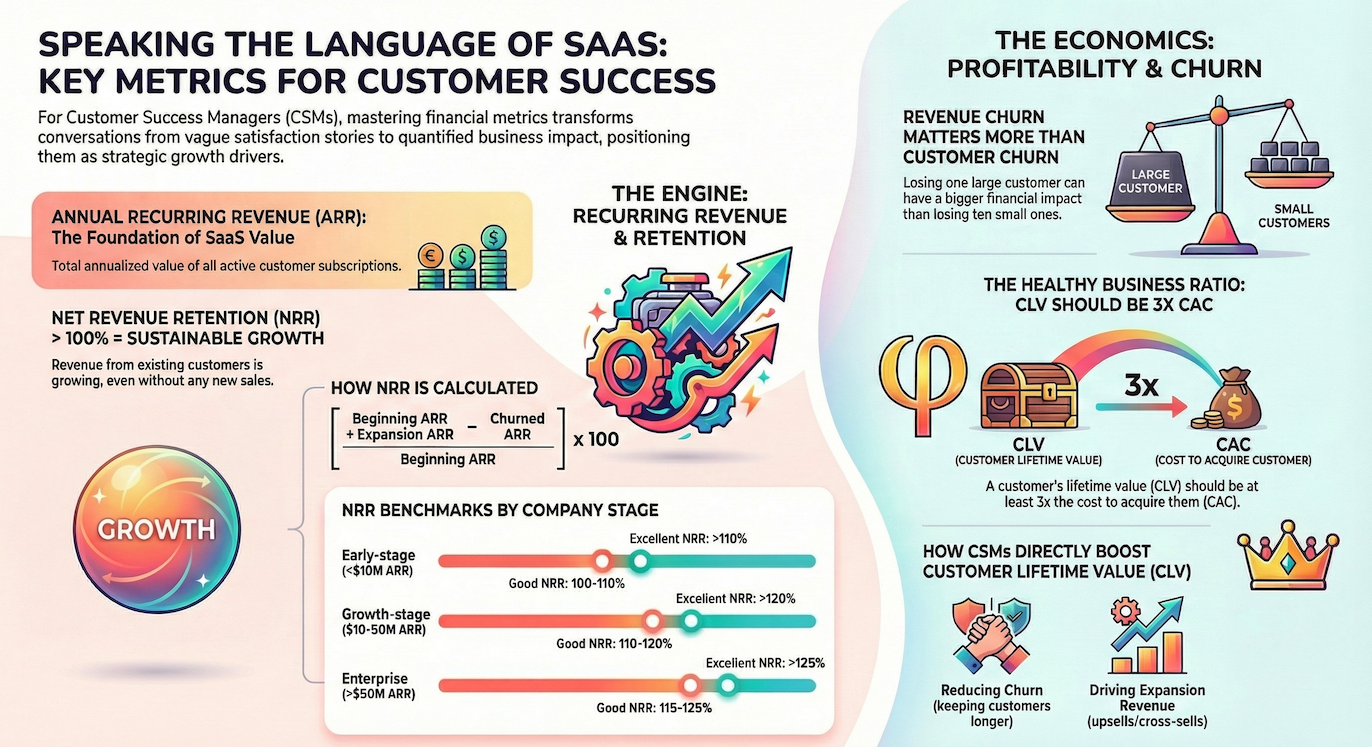
NRR = [(Beginning ARR + Expansion ARR - Churned ARR) / Beginning ARR] × 100Important: NRR excludes new customer revenue—it measures only existing customer retention and growth.
Example Calculation:
Scenario:
- Beginning ARR (existing customers): $10M
- Expansion ARR (upsells from existing): $2M
- Churned ARR (cancellations and downgrades): $1M
Calculation:
NRR = [($10M + $2M - $1M) / $10M] × 100
NRR = [$11M / $10M] × 100
NRR = 110%
Interpretation:
NRR > 100% (Excellent):
- Expansions exceed churn
- Existing customer base growing in value
- Sustainable growth model (can grow even if no new customers acquired)
- Typically indicates strong product-market fit and CS effectiveness
NRR = 100% (Neutral):
- Expansions equal churn
- Existing revenue flat (not growing, not shrinking)
- Growth dependent entirely on new customer acquisition
- Need to improve either expansion or reduce churn
NRR < 100% (Concerning):
- Churn exceeds expansion
- Existing customer base shrinking in value
- Unsustainable—must acquire new customers faster than losing existing
- Indicates product-market fit or CS execution issues
Industry Benchmarks:
| Company Type | Good NRR | Excellent NRR |
|---|---|---|
| Early-stage (<$10M ARR) | 100-110% | >110% |
| Growth-stage ($10-50M ARR) | 110-120% | >120% |
| Enterprise (>$50M ARR) | 115-125% | >125% |
Why NRR Matters:
For company:
- Primary indicator of existing customer health and expansion success
- Investors heavily weight NRR (companies with >120% NRR valued higher)
- Predicts sustainable growth potential
- Reflects product value and CS effectiveness
For CSM:
- Your primary performance metric in most SaaS companies
- Combines retention (don't lose customers) and expansion (grow accounts)
- Directly ties your work to company financial performance
- Often linked to variable compensation
NRR Components CSMs Control:
Expansion ARR (positive impact):
- Upsells (tier upgrades)
- Cross-sells (additional modules)
- Seat expansions (more users)
- Usage-based growth
Churned ARR (negative impact):
- Full cancellations (prevent through retention)
- Downgrades (minimize through value demonstration)
- Contraction (reduced seats or usage)
Example CSM Impact:
CSM managing $2M ARR book:
- Retained $1.9M (95% retention)
- Expanded $250K (12.5% expansion)
- NRR = [($2M + $250K - $100K) / $2M] × 100 = 107.5%
This CSM contributed 7.5% net growth from existing customers.
💡 Pro Tip: If your company provides NRR reporting, request your personal NRR for your book of business. Many CS platforms can calculate this per CSM. Knowing your individual NRR helps you understand performance relative to team and company targets. If company NRR is 115% but yours is 105%, you know you need to focus on expansion. If yours is 125%, you're outperforming and can share best practices.
━━━━━━━━━━━━━━━━━━━━━━━━━━━━━━━━━━━━━━
Best Practices: ARR and NRR Management
- Calculate ARR for your book of business and track monthly to understand your portfolio value
- Segment ARR into New, Expansion, and Churned components to see growth drivers
- Target NRR >110% for sustainable performance combining strong retention with meaningful expansion
- Track personal NRR monthly comparing against team and company benchmarks
- Focus expansion efforts on high-ARR accounts for maximum NRR impact
- Prevent churn from high-ARR accounts aggressively as single large churn significantly hurts NRR
- Use NRR in performance discussions: "I achieved 115% NRR contributing X to company target of Y"
- Understand that NRR measures existing customer performance excluding new acquisitions
━━━━━━━━━━━━━━━━━━━━━━━━━━━━━━━━━━━━━━
PART 2: CHURN METRICS - MINIMIZING REVENUE LEAKAGE
Track both customer and revenue churn to understand retention performance comprehensively.
━━━━━━━━━━━━━━━━━━━━━━━━━━━━━━━━━━━━━━
Customer Churn Rate
Definition: Percentage of customers lost over specific period.
Formula:
Customer Churn Rate = (Customers Lost During Period / Total Customers at Start of Period) × 100Example:
- Customers at start of Q1: 500
- Customers lost during Q1: 25
- Customer Churn Rate = (25 / 500) × 100 = 5%
Why Customer Churn Matters:
Tracks customer count dynamics:
- How many customers leaving?
- What percentage of base turning over?
- Is churn accelerating or decelerating?
Limitations:
- Doesn't account for customer size differences
- Losing small customer same impact as losing large customer in this metric
- Can be misleading if customer sizes vary significantly
Revenue Churn Rate
Definition: Percentage of revenue lost due to customer cancellations or downgrades.
Formula:
Revenue Churn Rate = (Churned ARR / Total ARR at Start of Period) × 100Example:
- Total ARR at start of month: $10M
- Churned ARR during month: $500K
- Revenue Churn Rate = ($500K / $10M) × 100 = 5%
Why Revenue Churn Matters:
Provides dollar-value perspective:
- How much revenue are we losing?
- What's financial impact of churn?
- Which customer losses hurt most?
Why Revenue Churn More Important Than Customer Churn:
Example scenario:
Month 1:
- Lost 10 small customers ($5K each) = $50K churned ARR
- Lost 1 large customer ($150K) = $150K churned ARR
- Customer churn: 11 customers lost
- Revenue churn: $200K lost
Analysis:
- Customer churn focused: "We lost 11 customers"
- Revenue churn focused: "We lost $200K ARR, 75% from single customer"
Strategic insight: Revenue churn reveals that preventing single large customer churn has more impact than saving 10 small customers combined. Helps prioritize CS time allocation.
Gross vs. Net Revenue Churn:
Gross Revenue Churn:
- Only includes losses (churn + downgrades)
- Excludes expansion revenue
- Shows pure leakage
- Formula: Churned ARR / Beginning ARR
Net Revenue Churn:
- Includes expansion revenue
- Can be negative (expansions exceed churn)
- Shows net impact on existing base
- Formula: (Churned ARR - Expansion ARR) / Beginning ARR
Example:
- Beginning ARR: $10M
- Churned ARR: $500K
- Expansion ARR: $800K
- Gross Revenue Churn: $500K / $10M = 5%
- Net Revenue Churn: ($500K - $800K) / $10M = -3% (negative churn!)
Negative net churn means expansion more than offset all churn and downgrades—existing base grew by 3%.
💡 Pro Tip: Track both customer and revenue churn to get complete picture. If customer churn is 10% but revenue churn is 3%, you're losing many small customers but retaining high-value accounts (good). If customer churn is 3% but revenue churn is 10%, you're losing few customers but they're your largest (bad). Revenue churn usually more important but customer churn reveals adoption/fit issues.
━━━━━━━━━━━━━━━━━━━━━━━━━━━━━━━━━━━━━━
Best Practices: Churn Metrics Management
- Track both Customer Churn Rate and Revenue Churn Rate for complete retention picture
- Focus CS efforts primarily on Revenue Churn as dollar impact matters more than customer count
- Calculate Gross Revenue Churn (pure leakage) and Net Revenue Churn (including expansion offset)
- Target negative net revenue churn through expansion exceeding any churn and downgrades
- Prioritize at-risk high-ARR accounts more heavily than at-risk low-ARR accounts for maximum impact
- Segment churn analysis by customer tier, industry, or cohort to identify patterns
- Use revenue churn to justify CS resource allocation: "5% revenue churn = $500K lost annually = justifies 3 CSM hires"
- Track churn by CSM to identify who needs support vs. who's outperforming for best practice sharing
━━━━━━━━━━━━━━━━━━━━━━━━━━━━━━━━━━━━━━
PART 3: CAC, CLV, AND UNIT ECONOMICS
Understand customer acquisition efficiency and lifetime profitability driving sustainable growth.
━━━━━━━━━━━━━━━━━━━━━━━━━━━━━━━━━━━━━━
Customer Acquisition Cost (CAC)
Definition: Total cost of acquiring new customer including all sales and marketing expenses.
Formula:
CAC = (Total Sales + Marketing Expenses) / Number of New Customers AcquiredExample:
- Sales expenses: $500,000 (salaries, commissions, tools)
- Marketing expenses: $300,000 (campaigns, events, content)
- New customers acquired: 400
- CAC = ($500K + $300K) / 400 = $2,000 per customer
Why CAC Matters:
Indicates efficiency of customer acquisition:
- Lower CAC = More efficient acquisition
- Higher CAC = Expensive acquisition needing optimization
CAC trends:
- CAC increasing → Acquisition becoming less efficient (market saturation, increased competition)
- CAC decreasing → Acquisition improving (better processes, stronger brand)
CSM Impact on CAC:
CSMs don't directly control acquisition cost but impact it indirectly:
Referrals and advocacy:
- Happy customers refer others (zero CAC acquisition)
- Testimonials and case studies reduce sales cycle (lower CAC)
Expansion vs. new acquisition:
- Expanding existing customer typically 3-5x cheaper than acquiring new
- CSM-driven expansion improves overall customer acquisition efficiency
Customer Lifetime Value (CLV)
Definition: Total revenue a customer generates over their entire relationship with company.
Simple Formula:
CLV = (Average Revenue Per Customer) / (Customer Churn Rate)Example:
- Average Revenue Per Customer: $5,000 annually
- Customer Churn Rate: 10% annually
- CLV = $5,000 / 0.10 = $50,000
Alternative Formula (More Precise):
CLV = (Average Revenue Per Customer × Gross Margin %) / Customer Churn RateExample with margin:
- Average Revenue: $5,000 annually
- Gross Margin: 80%
- Customer Churn Rate: 10%
- CLV = ($5,000 × 0.80) / 0.10 = $40,000
Why CLV Matters:
Shows total value of acquiring and retaining customer:
- How much customer worth over lifetime?
- What can company afford to spend on acquisition?
- Where should retention and expansion efforts focus?
CSM Impact on CLV:
CSMs increase CLV two ways:
1. Reduce churn rate (denominator):
- Customer Churn 10% → CLV = $50,000
- Improve to 5% churn → CLV = $100,000
- Doubling CLV by halving churn
2. Increase average revenue (numerator):
- Average revenue $5,000 → CLV = $50,000
- Expand to $7,500 through upsells → CLV = $75,000
- 50% CLV increase through expansion
The CLV:CAC Ratio
Definition: Relationship between Customer Lifetime Value and Customer Acquisition Cost.
Formula:
CLV:CAC Ratio = CLV / CACExample:
- CLV: $50,000
- CAC: $10,000
- CLV:CAC Ratio = 5:1
Interpretation:
| Ratio | Health | Meaning |
|---|---|---|
| <1:1 | Unhealthy | Losing money on every customer (spending more to acquire than customer generates) |
| 1:1 to 3:1 | Concerning | Low margin, little buffer for error |
| 3:1 to 5:1 | Healthy | Industry benchmark, sustainable economics |
| >5:1 | Excellent | Strong unit economics, room to invest in growth |
Why CLV:CAC Ratio Matters:
For company:
- Primary indicator of sustainable economics
- Shows if business model works financially
- Guides acquisition spending decisions
For CSM:
- Your retention and expansion work directly improves this ratio
- Every percentage point of churn reduction increases CLV
- Every expansion dollar increases CLV
- Demonstrates business value of CS function
Example Impact:
Before CS optimization:
- CLV: $30,000 (15% churn, $4,500 annual revenue)
- CAC: $10,000
- Ratio: 3:1
After CS drives improvement:
- CLV: $60,000 (8% churn, $4,800 annual revenue through expansion)
- CAC: $10,000 (unchanged)
- Ratio: 6:1
Business impact: CS doubled CLV:CAC ratio from 3:1 to 6:1 making business far more profitable and sustainable.
━━━━━━━━━━━━━━━━━━━━━━━━━━━━━━━━━━━━━━
Best Practices: CAC, CLV, and Unit Economics
- Understand CAC for your customer segment to know acquisition cost your retention must overcome
- Calculate CLV impact of retention improvements: Reducing churn from 10% to 5% doubles CLV
- Track CLV:CAC ratio for company and understand healthy benchmark is 3:1 to 5:1
- Demonstrate CS value through CLV impact: "Reduced churn 5% increasing CLV by $20K per customer"
- Focus retention efforts on high-CLV customers for maximum business impact
- Drive expansion to increase average revenue per customer improving CLV without increasing CAC
- Use unit economics to justify CS investments: "Tool costs $50K but increases CLV by $300K across base = 6:1 ROI"
- Recognize CS doesn't control CAC but significantly impacts CLV through retention and expansion
━━━━━━━━━━━━━━━━━━━━━━━━━━━━━━━━━━━━━━
PART 4: ADDITIONAL CRITICAL SAAS METRICS
Gross Margin
Definition: Revenue minus cost of goods sold (COGS), showing profitability before operating expenses.
Formula:
Gross Margin = Total Revenue - COGS
Gross Margin % = (Gross Margin / Total Revenue) × 100
What COGS includes in SaaS:
- Support and services costs
- Customer Success team costs
- DevOps and hosting costs
- Resold product expenses
- Infrastructure costs
Example:
- Total Revenue: $45,000 monthly
- COGS: $3,500 (CS team $2K, hosting $1K, support $500)
- Gross Margin = $45,000 - $3,500 = $41,500
- Gross Margin % = ($41,500 / $45,000) × 100 = 92.2%
Why It Matters: SaaS companies typically target 70-85% gross margins. Higher margins indicate efficient operations and scalability.
CSM Implication: CS costs are part of COGS. While CS drives revenue retention and expansion, team must be sized appropriately to maintain healthy margins.
Burn Rate
Definition: Amount of money being spent in given time period, showing how fast company consuming cash.
Formula:
Burn Rate = Total Expenses - Total RevenueExample:
- Monthly Revenue: $500,000
- Monthly Expenses: $750,000
- Burn Rate = $750,000 - $500,000 = $250,000 monthly burn
Runway Calculation:
- Cash in bank: $3,000,000
- Monthly burn: $250,000
- Runway = $3M / $250K = 12 months
Why It Matters: Shows how long company can operate before needing funding or profitability.
Average Revenue Per User (ARPU)
Definition: Average revenue generated per active customer.
Formula:
ARPU = MRR / Number of Active CustomersExample:
- MRR: $100,000
- Active Customers: 2,000
- ARPU = $100,000 / 2,000 = $50 per customer monthly
Why It Matters:
- Tracks monetization efficiency
- Expansion increases ARPU
- Helps segment customers by value
CSM Impact: Expansion activities increase ARPU across book of business.
━━━━━━━━━━━━━━━━━━━━━━━━━━━━━━━━━━━━━━
Best Practices: Additional Metrics Understanding
- Understand Gross Margin to see CS cost context (CS salaries are COGS affecting margins)
- Monitor Burn Rate to understand company cash position and runway affecting resource availability
- Track ARPU for your book measuring monetization efficiency and expansion success
- Use ARPU to identify expansion opportunities: Customers below average ARPU may have growth potential
- Calculate Gross Margin impact when requesting CS resources: "Adding CSM costs $100K but retains $500K ARR = minimal margin impact, large revenue protection"
- Understand Burn Rate context when company freezes hiring or cuts costs
- Use ARPU trends to measure expansion program success: ARPU increasing indicates effective upselling
━━━━━━━━━━━━━━━━━━━━━━━━━━━━━━━━━━━━━━
KEY TAKEAWAYS: BEST PRACTICES RECAP
✓ ARR is cornerstone SaaS metric measuring annualized recurring revenue, segmented into New ARR, Expansion ARR, and Churned ARR
✓ NRR measures existing customer retention and growth: >100% indicates sustainable model where expansion exceeds churn
✓ NRR formula: [(Beginning ARR + Expansion ARR - Churned ARR) / Beginning ARR] × 100, excludes new customer revenue
✓ Target NRR >110% for sustainable performance: Phase depends on company stage (early-stage 100-110%, growth-stage 110-120%, enterprise 115-125%)
✓ Track both Customer Churn Rate (% customers lost) and Revenue Churn Rate (% revenue lost) for complete picture
✓ Revenue Churn usually more important than Customer Churn as dollar impact matters more than customer count
✓ CAC measures acquisition cost efficiency through total Sales + Marketing expenses divided by new customers
✓ CLV shows lifetime customer value calculated as Average Revenue Per Customer / Customer Churn Rate
✓ Healthy CLV:CAC ratio is 3:1 to 5:1, with >5:1 indicating excellent unit economics
✓ CSMs increase CLV through two mechanisms: Reduce churn rate (doubling CLV by halving churn), Increase average revenue through expansion
✓ Additional critical metrics: Gross Margin (Revenue - COGS, target 70-85%), Burn Rate (Expenses - Revenue showing cash consumption), ARPU (MRR / Customers showing monetization)
✓ Calculate personal ARR and NRR for your book to demonstrate business impact: "Managed $2M ARR achieving 107.5% NRR through retention and expansion"